- by Crath
- Dec 28, 2025
The Games Universe(s)
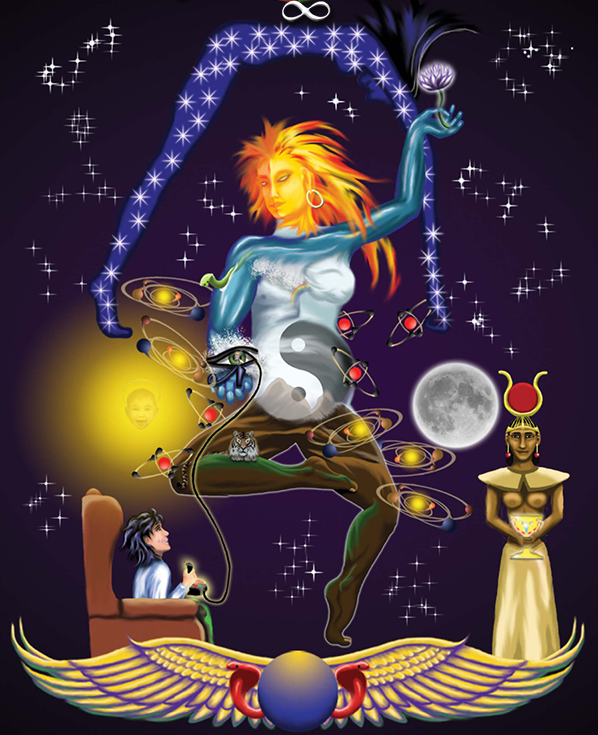
In truth, this was not a single universe. I've been in six so-called games universes for longer than this physical universe will have lasted by its end. All of these were shared spaces built upon common rules, and they each incorporated themes and motifs from prior ones. Choice selects for interesting things. Varying groups of beings also tend to pack up and explore subsequent universes together, resulting in nested collections of motifs as they go along.
Generally speaking, most of the "games universes" I participated in were much less solid than this physical universe. There was more free will and wiggle room around the edges.
Also, at least three partitioned games universes share anchor points with the Matter-Energy-Space-Time-Thought-Idea universe that we're "in" now. Configurations of persisting content across the five fundamental triangles governing separation, existence, manifestive power, experience, and understanding differ and evolve across cascading, interacting life vectors like a giant kaleidoscope; this apparent changing and cycling are pretended to be linearly connected and construed, at least by convention, as time tracks of change. Each configuration being infinite, truthfully inseparable from any other --All being indivisibly All-- all configurations exist at once, each infinite and outside of time; choices contain simultaneous consequences, all NINE FLOWS OF TIME coalescing into a single, n-dimensional möbius. As such, any comparisons of "time lengths" across or between games universes is as vainglorious as creation itself; time no more functions the same across universes as Einstein saw it behaving in ours.
Thus, one "Games Universe" to create and umpire concerns opening communication lines with oneself from "futures" or "pasts" from "elsewhere." Capabilities and awarenesses seem to drastically vary across these times, resulting in some wild effects.
A thing I've noticed about others' recollections of the Games Universe(s) is a tendency to differentiate them from misaligned spaces. One guy even describes "the Universe of Misaligned Spaces" -- like this isn't still going on. However designated, some universes contain(ed) gateways into others, and the further back you go on your time track(s), the more likely you are to find a chaotic mess of interconnecting spaces.
Let's talk fundamentals. This will be described in excruciating detail elsewhere, but for now, the initial creative construct conceived the potential for absence: nix-know, nix-responsibility, and nix-control. These were the emptinesses into which we extended by degree with various negations (and negations of negations), fostering wombs from which primal dichotomies emerged, initially as [what is / what is not; source / not-source], then stuff like [self/not-self; here/not-here; now/not-now], and eventually with bi-directional items that each exist as active negations of the other [good/evil; right/wrong].
I bring this up here to exemplify cascading patterns and how knowing what things were is just like knowing what things are and will be. It's all the same stuff persisting.
Games universes were full of traps, too. Traps add zesty spice.
For example, I recall a zipper universe where the ability to unzip one layer and step into a separate one was as normal as breathing into meat lungs is now. So, there we were, zipping from place to place or time to time, skipping the in-between entirely. It was literally how everyone got around there. This led to overlapping universes, in which it was possible to phase into other layers occupying the same space; only the content anchored to your present layer was supposed to affect you. The layered universe of His Dark Materials is a memory of this, as are portkeys and floo powder networks in Harry Potter, and transporter beams from Star Trek.
Anyways, one common trap in that zipper universe was to fool a player into believing the unzipped gateway was heading one place, when it was really tied to something else. Since travel was instantaneous, it could be quite disorienting. Also, since leaving universes early (or at all) could come with accompanying penalties, resets, or cooldown periods, tricking someone into leaving or otherwise breaching territory boundaries when they were deep into some game could get profoundly disruptive... and hilarious.
Given the state of the broken pieces on this present game board, one quick aside: Some object to the moniker "game" being applied to anything with significant consequences. To such losers wrapped in some insipid, pseudo-enlightened slave morality, their human life can't be a "game" because suffering and death are significant. It's worth clearing this up; a functional way to define "game" is as a collection of: 1) things you're trying to do; 2) things you are allowed to do (freedoms); and 3) things you cannot do (limits/rules). Games cannot exist unless all three of these things are going on, and attributing significance(s) does not alter this one bit. The establishment, interaction, and exchange of significances can be fun in itself -- like "growing up," for example.
A near-infinite array of games exist(ed) across these games universes, with appetites differing across players. Preferences for randomness, rates and degrees of change, sensation, risk, and everything else varied across them.
We created, participated in, collected, recorded, copied, and traded every imaginable game and configuration. Across iterations, one trend that emerged was scarcity. A few cycles of decay, which I'll get into later, resulted in loss of widespread abilities over iterations and consequent inabilities to freely recreate what was lost.
Eventually, this idea of only a finite amount of a thing existing became itself a source of amusement. Beings bartered, stole, and otherwise engaged in complex systems of cooperation and competition to amass the highest quality, most coveted, or the greatest quantity of such items. One diverting permutation of this involved marbles; in one universe they functioned as IOUs, and in another universe as a kind of democratic proxy vote system impacting the course of events -- whoever had the most marbles at that time could decide what happened next. Some clever sod got the idea that such currencies in one universe could be brought into another universe, like interplanetary (or intercontinental, or inter-country) credits, and used to purchase experiences. Sound familiar?
Banking and law have been with us longer than bipedal bodies.
It's a bit fractal, these patterns. The same configurations that were played out across universes were eventually all recreated and played out, albeit often in degraded manner, within single universes; then, between various galaxies (like one in our universe that literally uses art as currency); then within single galaxies, single solar systems, single planets.
Capability, responsibility, and awareness levels have further declined --same decay cycles, deeper down the well-- and the latest renditions of all these games are now enjoyed as video projections on flat screens into our jelly eyeballs and rendered by brain tissue. That folks are just remembering the good ol' days when they enjoy some shitty video game, as an escape from their decrepit state, is worth pondering. Apparently, sitting around reliving picture snippets of what used to be, anchored by unconsciousness to insufferable inauthenticity, isn't reserved only to those enmeshed in old, decayed bodies.
Another finding from early Games Universes was that gradient separation in space yielded tremendous potential fun and enjoyment. Eventually it caught on, and "time" as a dimension of space extended our playroom without adding an additional spatial dimension, so it kept things simple; prior dimensionality wars were awful. With this "time" construction, a thing could be in a place but then be removed and replaced by something else in that same space... except at a different time. Do you take that for granted now? Well, I'm still having fun with this, partly because it's possible to leave and read imprints in that same space, even as material persistences get moved around -- so it's possible to walk around and know what else happened there.
If you cannot visit these other places anymore, and perhaps are even in such bad shape that you can't remember any of this; if you never lived before and would like to; if you're just enjoying this cult experience of fiction gallivanting as more than random associations from a mishmash of science fiction and fantasy books; for these or any other reasons, you can read about one of my personal favorite games universe occurrences HERE.
you may also like
- by Crath
- Jan 08, 2026
Symbols Universe(s)
- by Crath
- Dec 28, 2025